Author: Mardi Pfeifer

  • Q&A with a Melody Maniac: Jameson Franken

    Q&A with a Melody Maniac: Jameson Franken

    To conclude a term’s worth of blog posts, I’ve chosen to interview my dear friend, Jameson Franken. Always introducing me to artists and records, Jameson has been a major source of my creative inspiration in the two short years I have known her. She majors in English at the University of Oregon (but is currently studying abroad in London), has a deep appreciation for music across all genres, and, like me, hails from the Southeast but moved to the West Coast in the seventh grade. Most notably—and fortunately for me—she has generously shared her time and wisdom with us in this Q&A.

    MP: Can you remember the first song artist that made you fall in love with music?

    JF: I would say the moment that I really, I knew that I was really, really into music is when my parents had this CD book and we had a CD player, andwe didn’t have a radio in the house, so that was kind of the only place that I could listen to music. I remember listening to Gloria Gaynor’s “I Will Survive” all the time. And then, slowly, I started listening to the other CDs. We had a Michael Jackson CD, and that was a phase for a little while. But I think really discovering the CD player and listening to loud music and good music that wasn’t just like pop hits on the radio was otherworldly for me.

    MP: How would you say your taste has evolved over the years?

    JF: That’s a really good question. My taste has evolved in a way that I love music, so I’m constantly searching for new music. So, like, as of recently, I just found this Egyptian artist, and I don’t understand anything that he’s saying, but I love the beat. So I would say it’s kind of, I really don’t know how to explain this, but it’s become a hobby.

    MP: What is the process you use when discovering new music? Do you have a certain step-by-step that you like to follow?

    JF: It’s a form of self-care for me. So I will be in my room. It’ll usually be a night that I have nothing to do. I’ll put my noise-canceling headphones on, and I’ll go on Spotify and just dig. Usually, I start with a song that I like, and then maybe I’ll go to the artist’s radio and look through the radio, or on Spotify, you can follow people and have followers. So I’ll go through my friends’ playlists, go off their friends’ playlists, look at my Discover Weekly, my release radar, all of that.

    MP: That’s great. And to tie back to your taste developing, would you say it’s changed in any way since you’ve spent time in London?

    JF: I think so. What I’m into in the current moment is definitely defined by the environment that I’m in. So right now, London is just coming out of the, like, foggy, super cold season, and it’s starting to get progressively sunnier. You can wear short sleeves, and much like Eugene, when there’s a little glimpse of sun, everybody gets super excited. There’s a pep in everyone’s step, everybody’s outside. And so my music taste has slowly gone from like shoegaze-type slower vibe, if you will, into something a little bit more upbeat. A little bit of house, a little bit of rock, a little bit of, you know, something that’s a little bit more uplifting.

    MP: Would you say that music affects your mood or mindset, in that you use it as a tool to pull you out of something, or do you use it to accentuate how you’re feeling in a given moment?

    JF: I would say that I use it to accentuate a feeling. So if I’m getting ready, I’m playing something again, upbeat, maybe rap to hype me up. If I’m sad, I’m going to indulge in that, and it’s going to be slow and not super high in pitch. And then if I’m happy, you know, it’s again, something more upbeat, lots of guitar.

    MP: Fun! Could you share an example with me of when you associated music with a certain memory or a life event?

    JF: I have this very vivid memory of walking [in] spring term of freshman year. I think I was walking from my 8 a.m. yoga class, and I put my headphones in. I’m walking back, and it was a pretty short walk, but the sun was out, and it was warm, and I listened to this song called “Shirim” by Melody’s Echo Chamber. And every time I listen to that song, I get a very, very visual memory of me walking down by the wreck and back to Bean.

    MP: That’s sweet. I know that feeling. It’s quite nice, and I love that song. I want to kind of dig into live music now or go to concerts. So what would you say is the best concert you’ve ever attended? 

    JF: I’m not sure that I can pick out the best concert that I’ve ever attended, but I can say my most favorites are when the performer is very, very thankful for the audience’s presence. You can tell that they want to be there. They enjoy performing; if anything, they interact with the audience. It feels good, and it’s just a cute moment of we are all here to see you, and we all enjoy this same thing. It’s very heartwarming. And so I would say that’s my favorite kind of live music event.

    MP: Unlike our TV girl experience, which was horrible. If you could see any artist, past or present, perform live, who would it be?

    JF: Oh, god, that’s a really good question. I think seeing a Led Zeppelin show would be super awesome. But like Led Zeppelin of the 70s, right when they were kind of becoming famous, I think that would be such an experience. Yeah?

    MP: My gosh, yeah. And going forward, what role do you think music will continue to play in your life?

    JF: I think music will always play an important role. I am nothing without my music. I have to have my headphones everywhere I go. I just think it will always remain a big part of my life and who I am, and for me, it kind of accentuates and makes life better. 

    MP: I agree. And you know, would you say there’s one thing that you maybe wish people understood about your love of music?

    JF: Music is a big part of me and who I am. It has made so many of my friendships. It can be romantic. It, you know, like you were saying, you can have memories associated with it. It’s something more than just listening. It’s emotional. It’s physical if you’re dancing, or if you really, really are feeling an emotion while listening to music; it is such a beautiful thing. And it’s not something that is just audible. There’s so much more to it, and there are also stories to be told about music and how it’s made, and where it came from, or how certain genres came to fruition, and stuff like that. I just, I think a lot of people are like, oh, yeah, music, that’s it. But I don’t think they understand how important it is, and it’s how important it’s been for centuries.

    MP: Yeah, yeah, I agree. With you. I feel like, I don’t know if you ever had this, but like, being in San Diego and having kind of a weird taste in music, I always got made fun of. Everyone was always like, don’t put Mardi on the aux. Like, don’t do it. She’s gonna play something weird. And I always was so frustrated. I like my friend’s music. I think that most of the music is great, and my friends have good taste in music, but they just weren’t ever interested in going deeper, and it frustrated me so much. But then I came to college, and everyone thought it was so cool. Yeah, so I agree with you. I wish people were more patient with it.

    JF: I also think there’s like, at least with technology, especially social media, there are some people in the world who say that they enjoy music, but it’s more so to amplify how they’re perceived by others. It’s a cool characteristic rather than a genuine one. I think music is very big in college, and again, it brings a lot of people together. Like, what is a frat party without music, really? What’s a bar without music? What’s a party without music, period? So, yeah, I think that’s totally understandable. And I get the whole idea of people thinking that your music taste is weird. I never experienced that in Portland, but I think if I had remained in South Carolina, it would have been the same. But that’s a whole other layer. 

    MP: Yeah, totally. And, you know, going away from this — if you wanted the reader to listen to one song, what would that be? I know that’s a heavy hitter, but what’s one thing everyone needs to hear at least once in their life?

    JF: “10 Years Gone” by Led Zeppelin.

    MP: Thank you. That’s fantastic.
  • How 90s Music Brought My Mom and Me Closer

    How 90s Music Brought My Mom and Me Closer

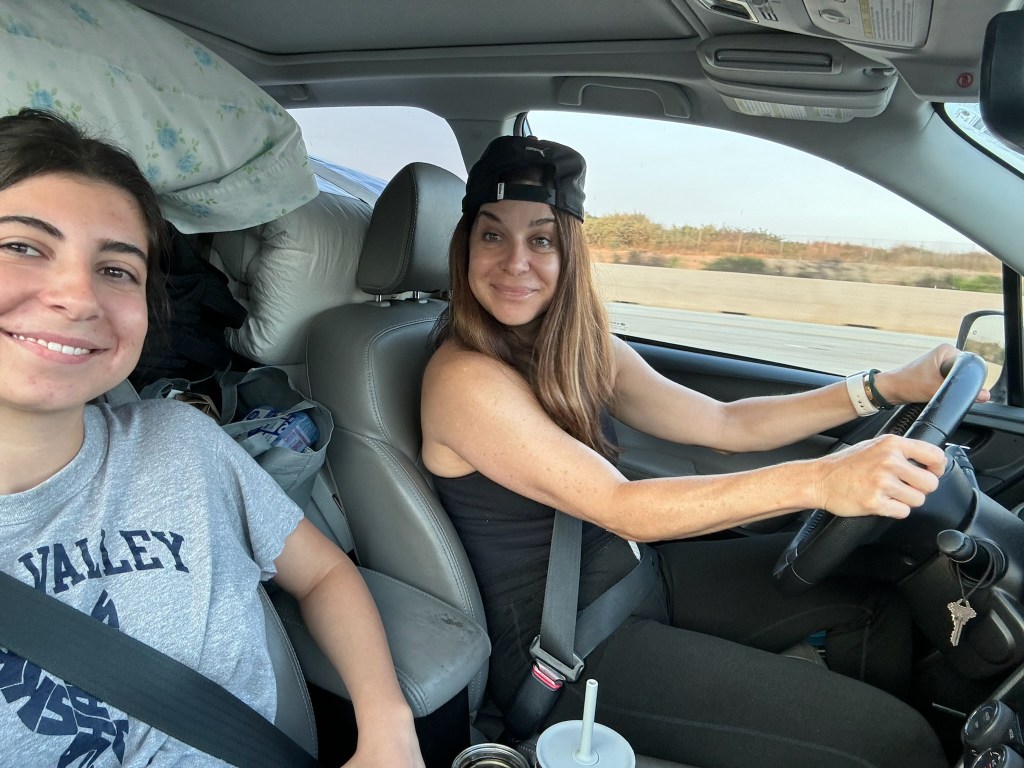
    Last summer, around mid-September, my mom and I made the daring trip from San Diego to Eugene, Oregon. While it was our third time doing so, this 800-mile drive felt a bit different. This time around, I wasn’t moving into a dorm or a sorority house, but a real-life, grown-up townhouse. It meant a total shift in responsibility – I would soon be cooking all of my own meals, housekeeping, and staying up-to-date with bills. 

    So, our road trip largely consisted of my mom sharing dozens of tidbits of advice about cleaning the refrigerator, grocery shopping and whatnot. But I, being cruelly stubborn and eager for more independence, didn’t give her the patience she deserved. Instead of listening, I hemmed and hawed, counting the miles until our arrival and meticulously organizing the queue of alternative tracks I played on the car stereo.

    Tensions only heightened as the drive progressed, so much so that we had entered “The Quiet Zone.” It was towards the end of the first day of driving, about halfway through our journey, and neither my mom nor I were speaking a word to each other. Just pure silence except for my downloaded Spotify playlists.

    But then- it happened. I played Alanis Morrisette’s “You Outta Know” and, together, through the rolling hills of Northern California, we belted every single lyric. After that, I blasted Pearl Jam. Both “Jeremy” and “Alive” because I knew how much those songs meant to her in high school. Next up was some Notorious B.I.G., of course. After that, I let my mom take full control of the music. I wanted to hear her recommendations, but most importantly, I wanted her to be happy.

    And that’s exactly what happened. While our road trip and move-in process was far from flawless, the spirits were much higher. Our karaoke session reminded me that while we may be working through different phases in life, we share so many things in common. These similarities should be appreciated and harnessed to strengthen our relationship. Because after all, my mom’s discipline and instruction will always come from a place of love, not competition.

    So nowadays, I choose to continue listening to moody rock and classic hip-hop of the 90s. Not just out of preference, but out of appreciation for my bad-ass mom who, thank God, is just a phone call away.

    P.S. I should share that I may have grown a little sappy in the last six months or so. With the dark cloud of college graduation rapidly approaching, closer ahead are the days that I can no longer spend a ten-day-long spring break with my family or procrastinate with finding a job. While the home in my heart will always be with Mom and Dad in SoCal, my real home will be where my career is, and I won’t be able to spend nearly as much time with them as I currently can. So I have vowed to make more of an effort to get to know them better, and ’90s jams are just the starting place.

  • Dissecting Two Music Industry Infographics

    Dissecting Two Music Industry Infographics

    While I originally planned to discuss 1990s music-related topics within both of this week’s blog posts because my topic covers a different decade each week, I found that using such specifications was difficult in finding strong infographic examples. So I simply chose to analyze two infographics reporting on listening preferences and sales in the music industry, both international and domestic.

    This first infographic titled “Music Industry: A Closer Look Into Streaming Services” was created by infographic.ly and divides information into five components. The poster’s use of just three colors – one neutral and two neon tones – provides a visually appealing factor that coincides with its modern statistics. There are two fonts used, ultimately creating a consistent tone throughout the piece. One bold copy headlines the poster and one narrow, taller font identifies the supporting statistics.

    Besides the title, the first delivery of information that my eye is drawn to shares that “music consumption formats have shifted due to growth of digital platforms,” then uses small images to demonstrate that these formats come as downloads, digital media players and streaming services. In all honesty, I do not believe that this snippet of information is necessary.

    The next three boxes are much more helpful, as they provide information in the form of creatively-displayed statistics. The first section uses a bar graph, arranged from largest to smallest, to show the allocations of worldwide listening revenue. Each bar is represented by a correlating image but I do wish that further explanation was provided to add context to the subdivisions. The other two are easily legible, with one using graphics resembling audio faders to show global digital music revenue across five leading countries and the other listing the listener/subscriber data of the four major streaming services under Spotify.

    The last category is the largest of all and displays the statistical impacts of the largest music streaming service, Spotify. It shows the different plans it offers, perks, most notable tracks/artist withdrawals, and the company’s overall value.

    Overall, I believe that this infographic served its purpose in providing a closer look into music streaming services. While it needed tweaking, all changes are minor and the data is effectively conveyed.

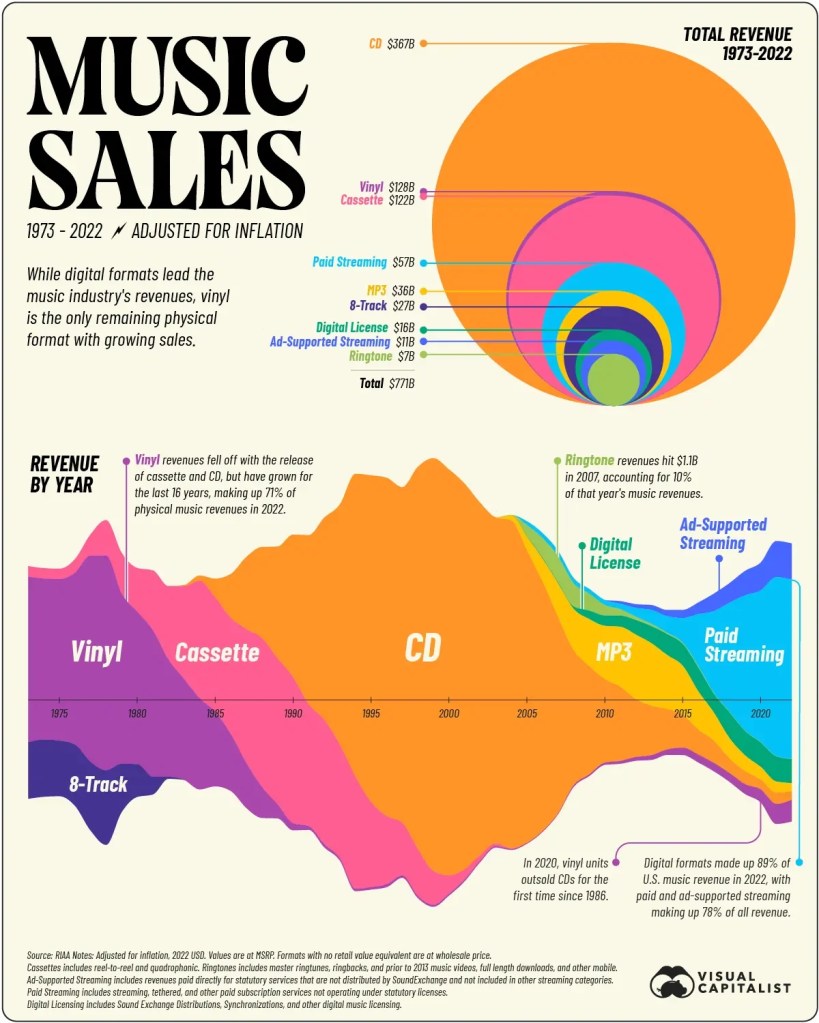
    The second infographic was created by Visual Capitalist and covers music sales in the United States from 1973 to 2022. In my opinion, this text-heavy profile is much more visually appealing than the other. It pairs a retro-style header and an italicized body copy with a vibrant range of tones, steering clear of monotonous shapes and lines.

    The first of two visuals illustrates the total revenue outlets of music listening. It uses overlapping circles to demonstrate that as of 2022, CD was the most profitable listening format by almost three times that of the runner-up vinyl records. The second chart uses colorful sound-wave-like shapes to distribute the revenue on a timeline spanning 49 years. The information of each graphic coincides with one another, but its creators chose to represent the music revenue in two formats so that readers could better understand the data. There are also cohesive explanations of each listening format to provide further clarity.

    I also believe that this infographic is strongly organized and successfully balances text and visuals. If I had a friend looking to learn more about the financial components of the American music industry, I would surely recommend this graphic.

  • Synthesizers, Drum Machines & The Sound of 80s Dance Pop

    Synthesizers, Drum Machines & The Sound of 80s Dance Pop

    When I think of the 1980s, my brain immediately rings with electronic piano keys and sparkling digital guitar chords. But what exactly are those sounds? And how did they define an entire decade of culture?

    The journey of electronic music began at the turn of the 20th century with the invention of the telharmonium, a 7-ton instrument that conducted electricity via telephone receivers to create sound. Though very impractical in size, this instrument provided the basis for the first synthesizer developed by the Radio Corporation of America (RCA) in 1955. Dubbed the Mark II, it was programmed using paper punchcards and revolutionized the future of music production.

    A decade later, electrical engineer Robert Moog introduced a synthesizer that represented a musical keyboard. Rather than using vacuum tubes (like the previous instruments), the Moog Modular Synthesizer harnessed the connection of control-voltage technology through short cables that could be plugged in and out as the user preferred. It was favored by the most famous musicians of the decade such as The Beatles, the Grateful Dead, and The Doors. 

    Several other brands made vital contributions to the early renditions of this instrument but everything shifted when Yamaha entered the market in 1974. With the introduction of the SY-1, users were able to manipulate sound velocity and after-touch sensitivity with the keys. By providing the inspirational basis for brands such as Sequential Circuits and Oberheim, further improvements to the synthesizer were made to the instrument’s accessibility, portability and sound range. This digital revolution gave birth to synth-pop, a genre defined by its sleek, futuristic aesthetic and infectious energy.

    What once began as a minimalistic – almost sterile – sound in the 70s was transformed in the 1980s to embody the new preference for vibrance and excitement. Three-minute tracks harnessed digital tempos and drum beats to accentuate lyrics emphasizing themes of romance, escapism or inspiration. While the synthesizer was heavily criticized as a soulless form of expression, young listeners loved it. And so did widely successful artists from the likes of Depeche Mode, Duran Duran and New Order who used the synthesizer to produce some of the most popular dance-pop tracks of all time.

    Nowadays, electronic instruments dominate the music industry. Virtual synths and drum machines are at the core of music production, shaping genres from K-pop to soul. Yet, it all sources back to the birth of synth-pop and the dawn of the digital age- journeys that still progress over a century later.

  • My Top 10 Favorite Dance-Pop Songs of All Time

    My Top 10 Favorite Dance-Pop Songs of All Time

    10: “Lucky Star” by Madonna

    Starting the list off strong is one of the first tracks to put Madonna on the map. With lyrics based on a famous nursery rhyme, “Lucky Star” was written as a thank you to Madonna’s friend and alleged beau Mark Kamins, the DJ at Danceteria who showed her music to executives at her first label Sire Records. 

    9: “Blue Monday ‘88” by New Order

    A remix of the band’s 1983 track “Blue Monday,” this song launched New Order into the electronic dance music scene. It was heavily influenced by artists such as Donna Summer, Kraftwerk and Ennio Morricone.

    8: “Raspberry Beret” by Prince

    Embedded within the lyrics of “Raspberry Beret,” Prince tells the story of a young man working at a five-and-dime store who falls for an unconventional and colorfully dressed woman. The song was a large leap from his previous funk ballads on Purple Rain.

    7: “I Wanna Dance With Somebody (Who Loves Me)” by Whitney Houston

    While this song has been criticized for its similarities to Cyndi Lauper’s “Girls Just Wanna Have Fun,” true lovers of Whitney Houston know how uniquely special it is. One of Houston’s greatest hits, it reached #1 on the Billboard Hot 100 and topped several charts in the UK, Canada and Australia.

    6: “Everybody Wants To Rule The World” by Tears For Fears

    Listening to this song brings me back to cruising down the Pacific Coast Highway during a spring sunset in high school. Its moody and melodic sound was a huge step away from the group’s beloved sound, which almost booted it from the 1985 album. Yet, producer Chris Hughes saw a vision with the track and the rest was history.

    5: “Smooth Operator” by Sade

    Through “Smooth Operator,” Sade blends pop and jazz to sing about a charismatic playboy whose irresistible spirit grants him any woman he pleases. But, the song highlights a dark element in the man’s craving for genuine connection. “Smooth Operator’s” seductive contrast was a beloved hit with listeners and helped launch the band into the international spotlight.

    4: “Don’t Stop ‘Til You Get Enough” by Michael Jackson

    Acting as a bridge between Jackson’s Motown roots and pop future, “Don’t Stop ‘Til You Get Enough,” was inspired by the star’s growing confidence and ambition. We can thank the disco, funk and soul sounds of artists such as Stevie Wonder and Earth, Wind & Fire for this infectious Jackson classic.

    3: “Father Figure” by George Michael

    I rediscovered this song thanks to the newly released A24 film, Babygirl, and have not been able to stop listening to it since. “Father Figure” was originally written to be a mid-tempo dance track but was transformed into a passionate, ethereal anthem before its release.

    2: “I Feel Love” by Donna Summer

    I need this song to be injected into my veins. The perfect dance track, the iconic ambiance of “I Feel Love” is entirely attributed to synthesized sounds and still holds tremendous cultural power today.

    1: “Vogue” by Madonna

    Yes, Madonna has made this list twice. She entirely deserves it. “Vogue” is what I believe to be the best dance-pop song of all time and was an instant global sensation. The music video was directed by David Fincher and played a huge role in introducing ballroom dance culture to a wider audience.

  • Entertaining the Youth, As Taught by the Pioneering Rock Labels of the 1970s

    Entertaining the Youth, As Taught by the Pioneering Rock Labels of the 1970s

    Ever wonder why your dad still refuses to listen to anything but Lynyrd Skynyrd or Steely Dan? Or why rock and roll became synonymous with 1970s teenage culture? To answer these questions, we have to step back and observe the masterminds behind the youth marketing revolution: rock record labels of the 1970s.

    So- what exactly did these labels do? And how did they become so successful? Stay tuned and find out.

    Fostering Artist Creativity and Authenticity

    In the decline of drug-induced, community-focused psychedelic rock from the 1960s, record labels were looking for something new. Rock music satisfied the craving for narcissism during the 70s, also known as the “me decade.” Music labels knew allowing artists and bands to dictate their social images through total creative control was the key to success. 

    For instance, KISS’s iconic otherworldly makeup was used as a tool to differentiate the band from other popular rock groups. The individualistic, gender-fluid elements of KISS resonated with younger fans seeking authenticity, ultimately creating a ripple effect for extreme creativity amongst the personas of 70s rock artists.

    Leveraging Visual Storytelling

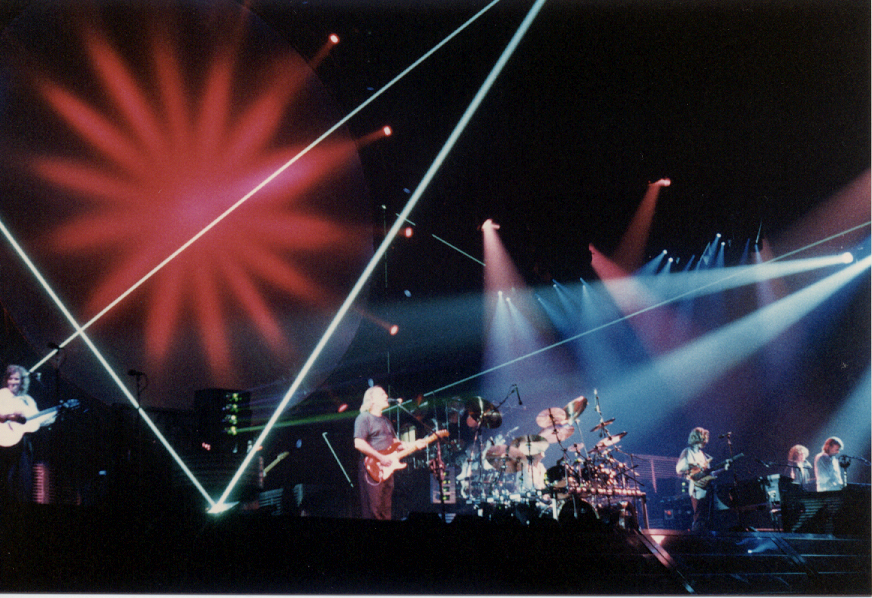
    Over 50 years ago, visuals were everything. Billboards and album artwork were the spaces where a label could partner its band or album with a single image, logo or even color scheme. Take Pink Floyd’s The Dark Side of The Moon, for example, released by Capitol Records in 1973. The immense success of the record permanently paired the musical group with the image of the iconic triangular prism refracting light into a spectrum of colors. What once began as just an album cover became a brand identity, utilized on billboards, posters, magazine advertisements and merchandise.

    Innovative Marketing Tactics

    To further appeal to the youth, record labels went straight to the source. With the use of magazines such as Rolling Stone, labels were able to issue written content though media coverage and visual promotions through paid advertisements. FM radio was also a huge tool of the 70s, with radio DJs fulfilling a similar role to social media influencers. They knew what was popular, what was up-and-coming and just exactly why teenagers wanted to hear it.

    The most impressive factor of these publicity efforts comes not from the immense creativity or research behind these campaigns, but because each album, artist or tour was able to be successfully marketed without social media. By tuning in to subcultures and reading the pulse of youth culture, music professionals were able to create marketing strategies that resonate today. So, the next time your dad cranks up “Sweet Home Alabama” in the car, take a moment to appreciate that his undying love for 70s rock isn’t just about the music—it’s also a testament to the brilliance of the publicists and record labels who turned these songs into cultural phenomena.

  • The 1970 Concert That Soundtracked the Birth of Greenpeace 

    The 1970 Concert That Soundtracked the Birth of Greenpeace 

    In 1970, the United States faced extreme political polarization from issues such as the Vietnam War, civil rights, economic instability and environmental protection. To spread awareness of these challenges, public figures, especially music artists, took it upon themselves to share their ideals with audiences in unique ways. 

    A strong example of this vocalism comes from the Amchitka benefit concert held in Vancouver, British Columbia, on Oct. 16, 1970. The show was the first fundraiser held by the Don’t Make a Wave Committee, now recognized as Greenpeace, and supported a boat expedition set to protest nuclear testing in Amchitka, Alaska. Featuring performances from rock/folk artists Joni Mitchell, James Taylor, Phil Ochs and Chilliwack, the sold-out concert raised over $17,000 for the campaign.

    A year after the event, on Sept. 17, 1971, 12 crew members embarked on a fishing trawler nicknamed “Greenpeace” to reach the Alaskan island. While the protest failed to stop the largest underwater explosion in U.S. history at that time, Amchitka never experienced another blast. Thanks to media coverage, the protesters’ voyage became a catalyst for increased public disapproval of nuclear weapons. Since then, Greenpeace has become a global leader in preventing ecological abuse and spreading environmental awareness through its organization of protests worldwide.

    One of Amchitka’s most notable factors lies in the originality of its forthcoming. As one of the first modern benefit concerts and examples of social responsibility demonstrated by the music industry, The event strengthened the relationship between mainstream entertainment and grassroots organizations. Today, this bond continues to inspire impactful collaborations. For instance: 

    • Billie Eilish’s partnership with REVERB to implement sustainable practices on her tour
    • Beyoncé’s collaboration with Artists Project Earth to fund disaster relief efforts 
    • Alicia Keys co-founded Keep a Child Alive, a non-profit that provides treatment for children affected by HIV/AIDS in Africa and India.

    The Amchitka benefit concert exemplifies music’s potential as a powerful tool for social change. By uniting art with activism, it set a precedent for future benefit concerts and artist-led campaigns addressing global issues. From its role in launching Greenpeace to inspiring modern-day collaborations between artists and grassroots organizations, Amchitka’s legacy underscores the enduring potential of music to amplify voices and drive meaningful change. As artists continue to embrace corporate social responsibility today, we can only hope that they carry forward this tradition of using their platforms to foster awareness and action on critical issues facing humanity and Earth.

  • Three Classic Folk Songs That Amplified Youth Voices During the Social Movements of the 1960s

    Three Classic Folk Songs That Amplified Youth Voices During the Social Movements of the 1960s

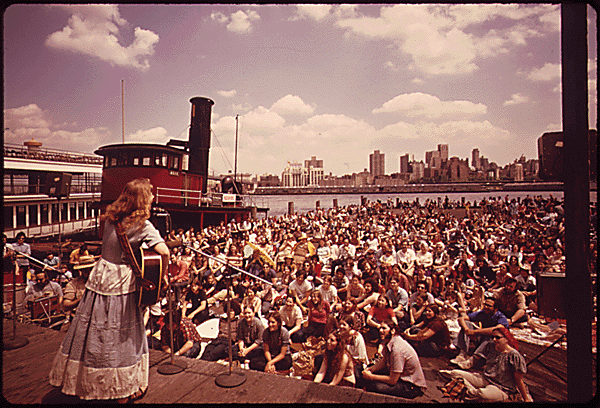
    During the 1960s, a time in which rebellion and counterculture triggered impactful social movements, folk music was mobilized as a powerful tool for activism. Through simple melodies and provoking lyrics, songs united a range of audiences with diverse cultural and educational backgrounds in a shared vision for a better world. Here are three classic folk songs that played a significant role in shaping this decade’s social landscape:

    “We Shall Overcome” by Various Artists

    While the original author/composer(s) of this iconic song are up for speculation, it was introduced to Martin Luther King Jr. by folk revival father Pete Seeger in 1957. Because of its memorable tone and essence, it proved easy to perform at sit-ins, marches, and rallies. “We Shall Overcome” was solidified as the anthem of the US Civil Rights Movement after Joan Baez’s recital of the song at the Lincoln Memorial during the August 1963 March on Washington. It was further dignified in former President Lyndon B. Johnson’s speech to Congress in the hearing for the Civil Rights Act of 1964, of which he stated: “These are the enemies: poverty, ignorance, disease. They are the enemies and not our fellow man, not our neighbor. And these enemies too, poverty, disease and ignorance, we shall overcome (Johnson, 1964).”

    “Blowin’ in the Wind” by Various Artists

    Originally written in 1962 by Bob Dylan, the themes embedded within the lyrics of this track have allowed it to be a representation of several of the political issues experienced in the 1960s and beyond. The song’s lines coincide with the Civil Rights Movement and Anti-War protests of the decade through direct address of the oppression and violence. Within the writer’s intricate symbolism, the solution for these issues exists all around us but is perpetually out of reach. “Blowin’ in the Wind” was famously performed by the likes of Joan Baez, Sam Cooke, and Dylan, but gained widespread popularity through Peter, Paul and Mary’s cover released in 1963.

    “A Change is Gonna Come” written and performed by Sam Cooke

    Argued by Rolling Stone (and yours truly) to be one of the greatest songs of all time, rumor has it that singer Sam Cooke was afraid to record “A Change is Gonna Come.” The track departed strongly from his former No. 1 hit “You Send Me,” but acted as a convergence between Cooke’s unique sound and rich history with gospel. While most of Cooke’s audience rejected the immediate release of the record, activists of the Civil Rights Movement embraced it with open arms and the rest was history. 

    The enduring power of these folk songs lies in their connection to America’s musical heritage.  During the early centuries of the United States, slaves used singing in times of spiritual support, as a documentation of experiences, and even as a covert means of communication. By tapping into cultural memories such as these, the fluid power of song mobilized a generation of activists. Their legacy resides in the voices of today, reminding us of music’s ability to articulate shared aspirations for social change.

  • Guardians of Sound: The Story of Folkways Records and Its Smithsonian Legacy

    Guardians of Sound: The Story of Folkways Records and Its Smithsonian Legacy

    Folk music, as defined by Britannica, is a type of traditional and generally rural music that originally was passed down through families and other small social groups. Because its definition varies through the opinions of differing social classes, it acts as a culmination of genres. To some, folk music is the song of a cultural identity, while others view it as a spiritual expression. Despite these variations, folk music is united by its simple instrumentation and strong oral tradition. In the 1960s, Folkways Records played a pivotal role in preserving and popularizing this art form, bringing its rich heritage to new audiences and fueling the folk revival that defined a generation.

    Founded in 1948 by Polish radio engineer Moses Asch and his assistant, Marian Distler, Folkways Records was dedicated to documenting sounds and songs from all walks of life. With over 2,000 published recordings from 1949 to 1987, Folkways became one of the most impactful music labels in history. Tracks such as “This Land is Our Land,” by Woody Guthrie and and Elizabeth Cotten’s “Freight Train” inspired young artists of the 1960s such as Bob Dylan and Simon & Garfunkel, paving the way for the resurgence of folk music. 

    Towards the end of his life, Moses Asch searched for an inheritor of Folkways Records, ultimately deciding on the artistic director of the Smithsonian’s Folklife Festival, Ralph Rinzler. Under the requirement that each of the label’s recordings remained in print forever, so that people could always have access to these oral traditions, Rinzler agreed. Asch died before the completion of the deal, but his family eventually donated the label to the Smithsonian Institute in 1987.

    Smithsonian Folkways Recordings, as it is now called, is a non-profit organization based in Washington, D.C., composed of a culmination of almost two dozen other publishers and collections including Asch’s label. It has a strong digital presence on social media platforms, websites, and in the press as a cohort of the National Museum of the United States. Dedicated to heritage preservation and highlighting cultural diversity from all across the world, it upholds these practices through the development of Smithsonian Folkways Recordings Music Pathways, and Global Sound Initiative, education programs for teachers, students, and listeners of all ages. 

    Through my research on the timeline and impacts of Smithsonian Folkways Recordings, it’s clear that this organization continues to meet vital community needs. With an extensive collection of over 5,000 albums and nearly 60,000 songs, Smithsonian Folkways Recordings has cemented its role as a guardian of diverse musical traditions. Its vast archive not only preserves the timeless nature of oral traditions but also ensures their accessibility to future generations.

  • Laying the Groundwork…

    Laying the Groundwork…

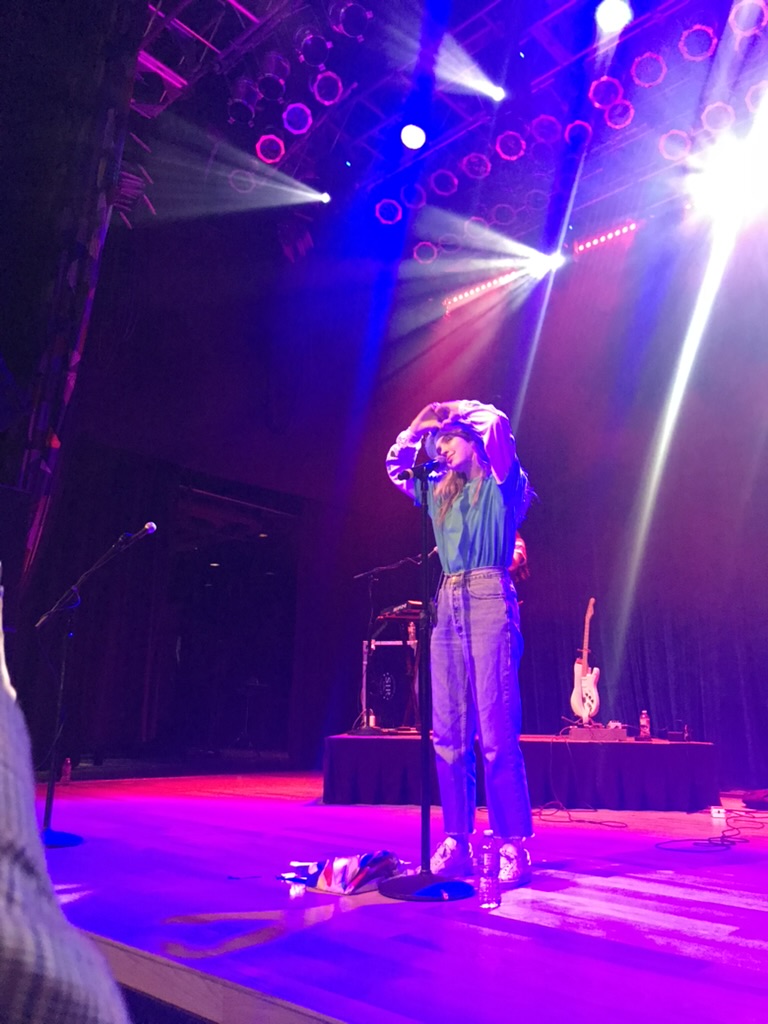
    At the age of fourteen, I attended my first concert. It was a small-scale indie show for a then-bedroom-pop artist who has since soured into popularity and transitioned into new-age folk. In the two hours that she performed as my friend and I watched from the front row (while my mom waited from the bar), I became entranced by the environment. The lights, sounds, and affection that pulsated through the audience marked a significant moment in my life, as that was when I fell in love with music.

    Since that night, I have dabbled in my fair variety of tangible music facets in hopes of discovering my angle into a music industry career. I lost hope in becoming a musician through my failed attempts at the flute and electric guitar, crashed then burned because of a short-lived DJing hobby, and am well aware that singing is not my forté. Yet, after each of these of these strides, my love for music never wavered. Each attempt brought me back to what I loved most: observing the allure of it all. Whether I was going to shows, curating playlists, or reading up on the chronicles of bygone artists, these were the moments that brought me to understand my potential as a behind-the-scenes contributor to this industry. 

    Over time, I have realized that my true passion lies in uncovering and understanding the stories behind the music. Every song and album carries a history shaped by cultural moments, personal struggles, and, significantly, public relations. I am fascinated by the power of storytelling in music – how a genre can rise to fame with the right message, image, or connections.  So, in hopes of strengthening my knowledge of music’s expansive history, I have chosen to dedicate this blog to dissecting how public relations shaped the music landscape and paved the way for the successes of famous genres from recent decades. 

    Each week, I will uncover the roots of a genre, the key players in its popularity, and how it was influenced by the media landscape.

         Week One: 1960s and Folk

         Week Two: 1970s and Rock

         Week Three: 1980s and Dance-pop

         Week Four: 1990s and Hip-hop

         Week Five: 2000s/2010s and Electronic Dance Music

    As for my readers, I hope that these posts richly enhance the way you listen to music. By uncovering the stories behind the sounds, I aim to enhance your appreciation for the artistry and strategy that define each genre. I approach this project not as an expert, but as an observer, eager to familiarize myself with this vibrant and creative world.